
Un film eccezionale!
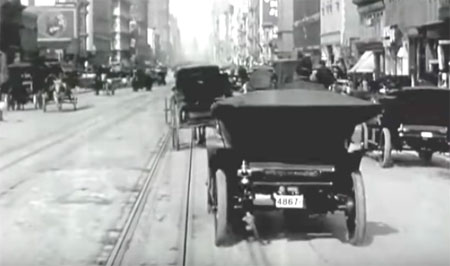
Un salto nella San Francisco dei primi del 1900.
Un film straordinario, sonoro, che ti fa vivere lungo la strada così piena di vita, è il 14 aprile 1906.
Una sensazione unica, che neppure immagini. (m.g.)
Questo film è stato girato il 14 aprile 1906, appena quattro giorni prima del terremoto e del fuoco di San Francisco, a cui il negativo era quasi perso.
È stato prodotto dai commoventi fotografi in movimento dei fratelli Miles: Harry, Herbert, Earle e Joe. Harry J. Miles mise in moto a mano la telecamera Bell & Howell che era stata posizionata sulla parte anteriore di una funivia durante le riprese di Market Street dall'8 °, di fronte ai Miles Studios, fino all'edificio del Ferry.
Pochi giorni dopo i fratelli Miles erano in viaggio per New York quando hanno saputo della notizia del terremoto.
Mandarono il negativo a New York e tornarono a San Francisco per scoprire che i loro studi erano stati distrutti.
L'origine del film è stata un enigma per molti decenni, e si pensava da tempo che fosse stato girato nel settembre del 1905, dopo essere stato datato come tale dalla Biblioteca del Congresso in base allo stato di costruzione di diversi edifici.
Tuttavia, nel 2009 e nel 2010, lo storico del cinema David Kiehn, co-fondatore del Niles Film Museum di Niles, in California, ha datato il film alla primavera del 1906 da immatricolazioni automobilistiche e dati meteorologici.
Alla fine Kiehn trovò materiale promozionale dall'uscita originale del film e datò il film al 14 aprile 1906, e alla fine diede credito ai cineasti, i Miles Brothers.
Film:
Sound mix: Silent
Color: B&W
Aspect Ratio; 1.33 : 1
Negative Format: 35 mm
Printed Format: 35 mm
Cinematographic Process: Spherical
Camera: Hand-cranked Bell & Howell
Video format:
HDTV 1080I (1920 x 1080)
Pixel Aspect: Square
Editing Timebase 29.97
Compressor : H.264
Audio:
28 tracks, stereo. (without panning)
Restoration:
This version was transferred from a new 35mm print made from a restored 35mm negative, taken from the 1906-era 35mm print owned by the Prelinger Archives. This version does not appear to have any digital restoration, except minimal contrast and brightness adjustments.
Post Effects:
This version of the film has been digitally stabilized to remove jitter by youtube user Rick88888888 in 2011.
Resources:
Sounddogs, Youtube, Horseless.com, Wikipedia, Archive.org, Streetcar.org, earlyamericalautomobiles.com, Prelinger Archives, Niles Film Museum.
Music:
"Crazy Rhythm" played by Brad Kaye.
Accuracy:
Automobile sounds are all either Ford Model T, or Model A, which came out later, but which have similarly designed engines, and sound quite close to the various cars shown in the film. The horns are slightly inaccurate as mostly bulb horns were used at the time, but were substituted by the far more recognizable electric "oogaa" horns, which came out a couple years later. The streetcar sounds are actual San Francisco streetcars. Doppler effect was used to align the sounds.
Produced by:
The Miles Brothers
Photographed by:
Harry J Miles
Sound Design by:
Mike Upchurch
-------------
Tratto da: https://www.youtube.com/watch?list=RD8Q5Nur642BU&v=8Q5Nur642BU